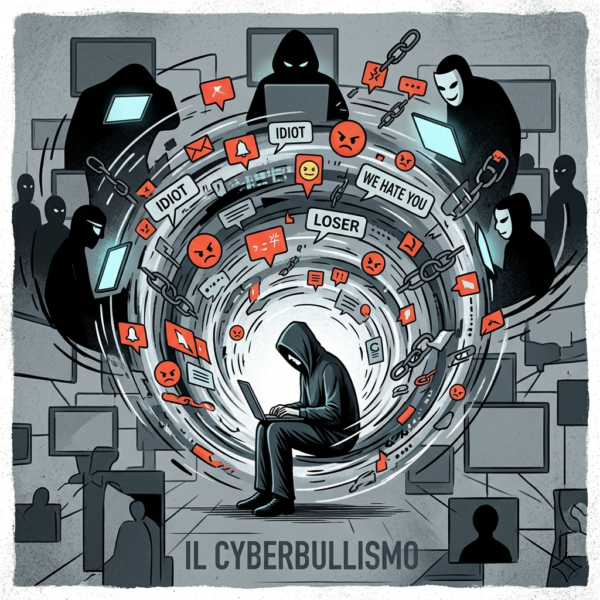
Cyberbullying is the digital version of traditional bullying, but with certain characteristics that make it, if anything, even more insidious. It is defined as a set of aggressive and intentional actions carried out by a single person or a group using electronic tools (social media, chats, emails, online games).
Unlike face-to-face bullying, cyberbullying has three critical elements:
Anonymity (real or perceived): The bully often hides behind a nickname or a fake profile. This reduces the sense of responsibility and increases aggression (the so-called toxic disinhibition).
No space or time limits: While school bullying ends when the bell rings, cyberbullying follows you everywhere. The bully is in your pocket, on your smartphone, 24 hours a day.
Enormous audience: An insult written on a wall is seen by very few; a humiliating video or post can be shared thousands of times in minutes, going viral and becoming virtually impossible to delete entirely.

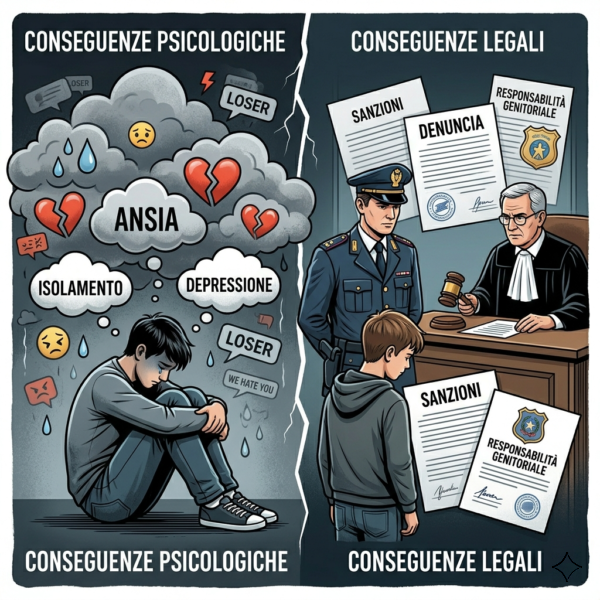
The consequences of cyberbullying are profound and affect not only the victim, but often the perpetrator as well.
For the Victim: Social isolation and depression: the feeling of being attacked by everyone leads to withdrawal. Psychosomatic symptoms: headaches, stomach aches, insomnia and panic attacks. Drop in academic performance: school becomes a place of anxiety rather than learning. Extreme thoughts: in the most serious cases, the constant sense of humiliation can lead to self-harm.
For the Cyberbully (Legal Consequences): In Italy, cyberbullying is not just “wrong behaviour” — it can constitute several criminal offences. Defamation means damaging someone’s reputation online (Art. 595 of the Penal Code). Stalking applies if harassment is repeated over time (Art. 612-bis of the Penal Code). Revenge Porn involves sharing intimate images without consent. Parental responsibility means that if the bully is a minor, parents may be required to pay compensation for the economic and moral damages caused by their child (culpa in educando).
The case of Carolina Picchio is the tragic turning point that changed how this phenomenon is perceived in Italy. Carolina was a 14-year-old girl from Novara — outgoing and sporty.
In 2013, at a party, Carolina felt unwell. Some of her peers, instead of helping her, filmed the scene making sexual gestures and mocking her. The video was then uploaded to social media and received thousands of insults and vulgar comments. Carolina could not bear the weight of that public humiliation and, after writing one last message, took her own life.
“Words hurt more than punches. God, how much they hurt.” — From Carolina Picchio’s last letter.
Carolina’s Legacy: Thanks to the efforts of her father, Paolo Picchio, and her then-teacher (later Senator) Elena Ferrara, Law 71/2017 was passed in 2017 — the first law in Europe to protect minors against cyberbullying. This law now allows young people to directly request the removal of offensive content from websites and social media platforms.