
The World as a Character
Manzoni dedicates memorable pages to describing seventeenth-century Lombardy: customs, social hierarchies, the corruption of Spanish justice, the misery of the countryside. Every detail transforms the protagonists’ choices into necessary actions. Renzo cannot marry Lucia because don Abbondio is afraid, and don Abbondio is afraid because in that world the bravi exist. The world determines the characters, and the characters reveal the world. In the same way, in narrative video games such as The Witcher 3 or Elden Ring, the world is not a picturesque backdrop but an active interlocutor that gives moral weight to the player’s decisions.
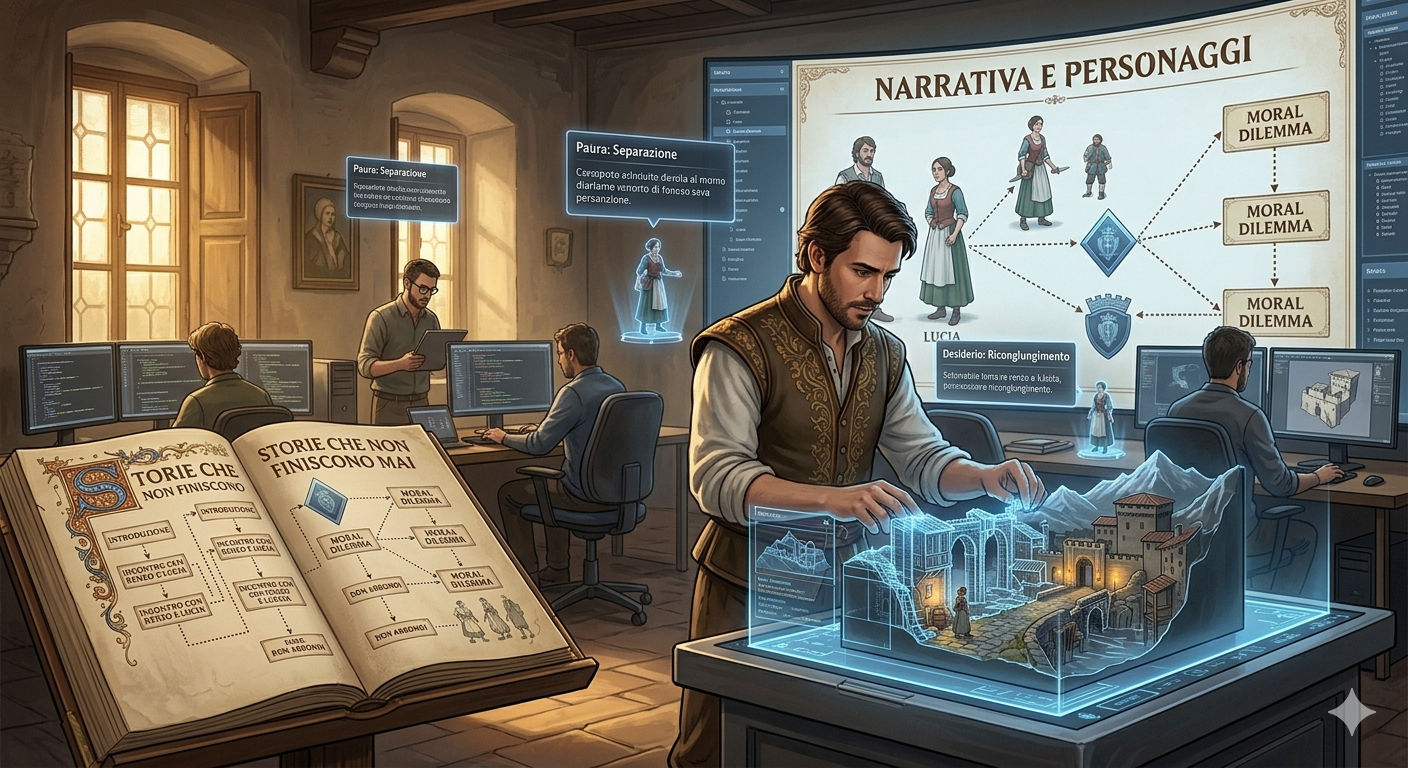
Stories that never end: narrative, characters and worlds
When Alessandro Manzoni published The Betrothed (I Promessi Sposi), nobody would have imagined that the narrative techniques he had adopted would become the foundation of an entirely new art form: the construction of a credible world, the creation of characters driven by desires and fears, guiding the reader through a story that questions them morally.
Archetypes and Complexity
In The Betrothed we encounter archetypal figures: Renzo the impulsive one who learns to control himself, Lucia the true moral pillar of the novel, don Abbondio the cowardly opportunist. The same logic governs the characters of contemporary video games: Geralt of Rivia is built on the contradiction between his nature as an outcast and his rigid moral code; Joel in The Last of Us is the traumatised parent who transforms pain into protective violence.
The Narrator and Point of View
Manzoni constructs an omniscient and ironic narrator who guides the reader morally. In video games this function splits in two: an authorial voice still exists in cut-scenes and dialogue, but the player themselves becomes co-author through their own choices, as happens in Disco Elysium or Planescape: Torment. The great Manzonian narrative techniques therefore survive and evolve in contemporary video game art.