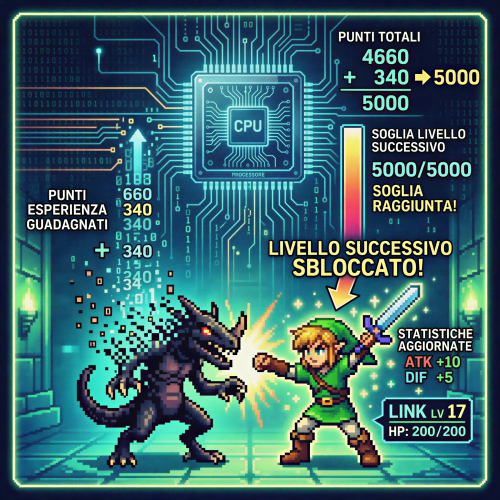
Every progression in a game is a series of calculations managed by the processor. When you defeat an enemy or complete a mission, the computer does not “understand” the concept of level, but performs a simple arithmetic operation: it adds the experience points you have gained to those you already had. If the total exceeds a pre-set threshold, the processor automatically unlocks the next level and updates all your statistics.
Quadratic Equations and Hitboxes
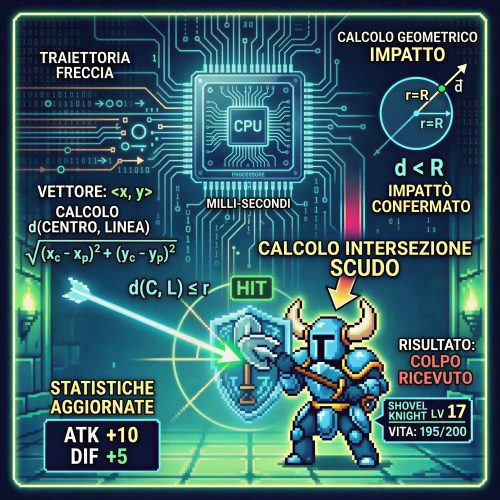
To determine whether a hit has struck its target, the processor performs geometric calculations in real time. Imagine your character is protected by a circular shield: to find out whether an arrow will hit it, the computer calculates whether the projectile’s trajectory crosses the shield’s perimeter. Based on the result of this calculation, the game instantly determines whether you have taken damage or dodged the blow. All of this happens in a few milliseconds, without the player even noticing.
Quadratic Equations and Hitboxes
To determine whether a hit has struck its target, the processor performs geometric calculations in real time. Imagine your character is protected by a circular shield: to find out whether an arrow will hit it, the computer calculates whether the projectile’s trajectory crosses the shield’s perimeter. Based on the result of this calculation, the game instantly determines whether you have taken damage or dodged the blow. All of this happens in a few milliseconds, without the player even noticing.
Coordinates and 3D World Matrices
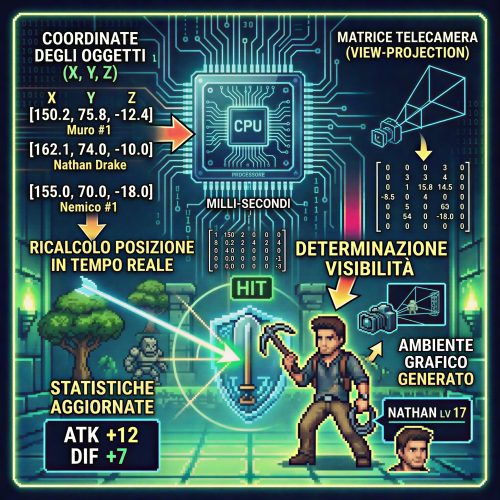
The position of every object in the game is defined by three numbers indicating where it is in virtual space. When you move the camera, the processor recalculates in real time the position of every element in the scene — trees, walls, enemies — to determine what must appear on screen and from which angle. It is this continuous work of calculation that transforms a series of numerical data into the graphical environment the player sees and perceives as real.
🧮 Mathematics Quiz – 10th Grade
1. Solve the equation $2x - 5 = 3x + 2$. What is $x$?
2. What is the solution of the system $\begin{cases} y = 2x + 1 \\ y = -x + 4 \end{cases}$ ?
3. Simplify the radical expression: $\sqrt{50} - \sqrt{18} + \sqrt{8}$
4. In a right triangle, the legs measure 5 cm and 12 cm. How long is the hypotenuse?
5. Solve the inequality $x^2 - 5x + 6 \gt 0$
6. The line with equation $y = -\frac{1}{2}x + 3$ has a slope of:
7. When rolling two dice, what is the probability that the sum is 7?
8. What is the vertex of the parabola $y = x^2 - 4x + 5$ ?