Empyrean

Algorithms and the Game Loop


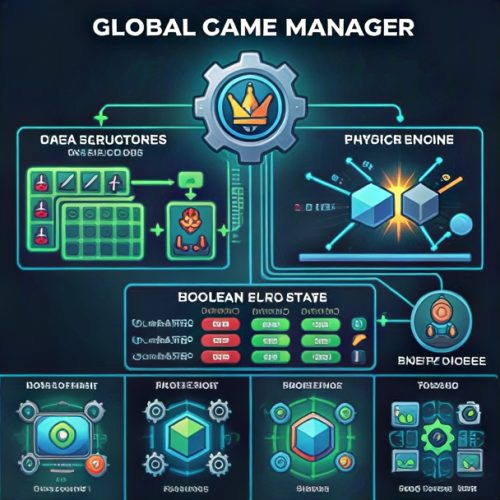
At the heart of every video game lies a fundamental computing concept: the Game Loop. Think of it as the software’s heartbeat. Every fraction of a second, the computer runs an infinite cycle of operations: it reads your inputs (a key press), updates the state of the world (moves the character), and renders the final image.

Memory management: Essential for loading textures and sounds without crashing the system.

Conditional logic: If the player touches an enemy, subtract health. Without Boolean logic and data structures, the game would be a static film.

watermark-removed-game-loop-informatica-300x300

Mathematics becomes visual

watermark-removed-mate-informatica-300x300


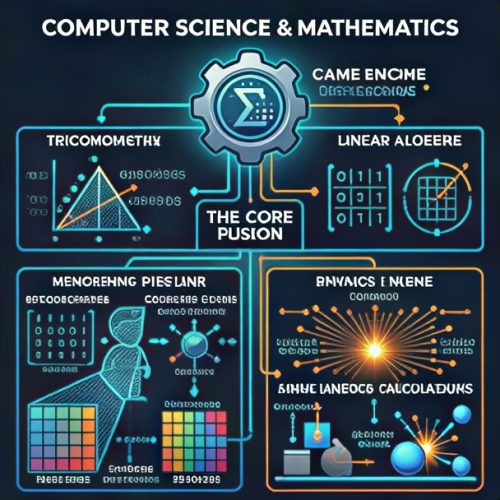
The clearest link between computing and gaming is in the Game Engine (such as Unreal Engine or Unity). Here, computing merges with trigonometry and linear algebra. Every time you see a shadow move realistically or an object fall, you are watching the work of:

Rendering Pipeline: The process that transforms 3D mathematical coordinates into coloured pixels on screen.

Physics Engines: Software that simulates gravity, friction and collisions. For the computer, an explosion is nothing more than the calculation of thousands of vectors moving through space at the same instant.

Mathematics becomes visual​

watermark-removed-mate-informatica-300x300

The clearest link between computing and gaming is in the Game Engine (such as Unreal Engine or Unity). Here, computing merges with trigonometry and linear algebra. Every time you see a shadow move realistically or an object fall, you are watching the work of: Rendering Pipeline: The process that transforms 3D mathematical coordinates into coloured pixels on screen. Physics Engines: Software that simulates gravity, friction and collisions. For the computer, an explosion is nothing more than the calculation of thousands of vectors moving through space at the same instant.
Artificial Intelligence and Networking

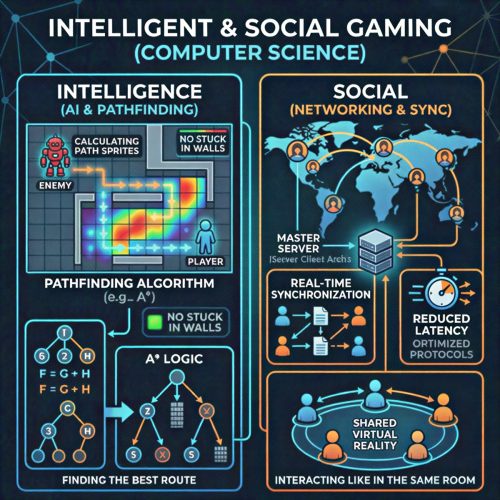
Computing allows the game to be “intelligent” and “social”. Artificial Intelligence (AI) in games is not about creating consciousness, but about using pathfinding algorithms (such as the A* algorithm) to ensure an enemy finds the best route to reach you without getting stuck in walls. On the networking side, computing manages the synchronisation between thousands of players around the world. Thanks to optimised network protocols, the system reduces latency (the infamous lag), allowing people on different continents to interact in a shared virtual reality as if they were in the same room.

watermark-removed-admin-ajax